Cleared by PT but Not Ready for Group Pilates? The Gap in Between
- 4 min
- read
- 6 steps
- in this guide
- Ruby
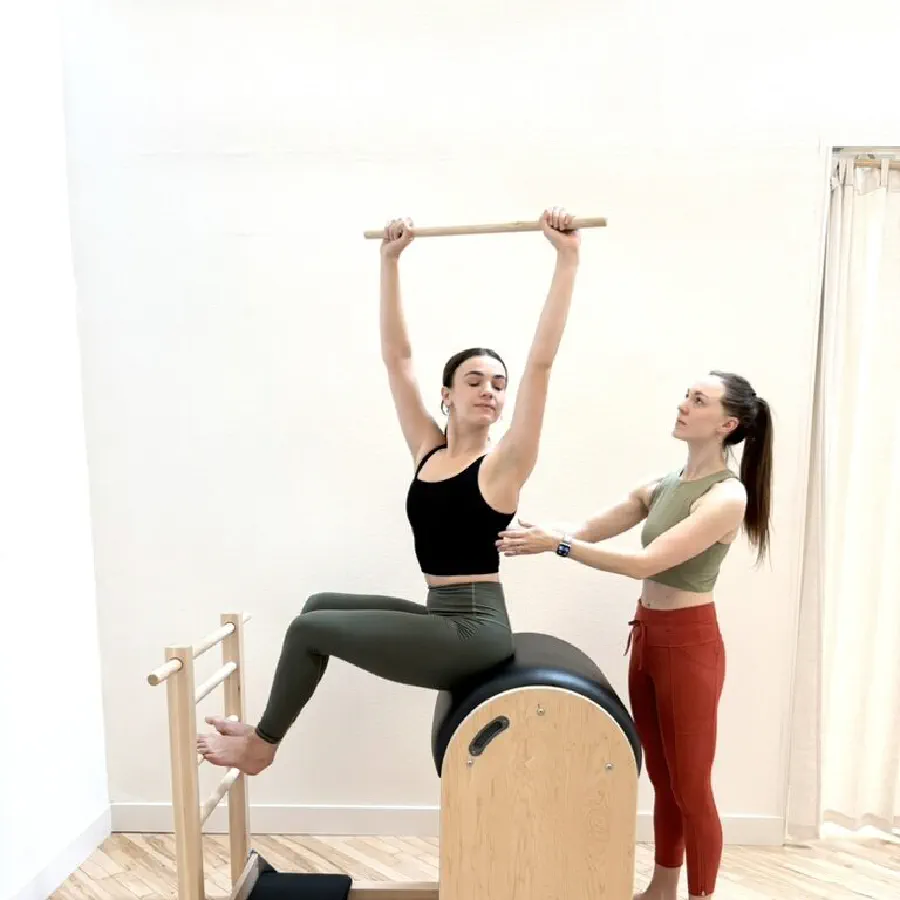
Your physical therapist says you’re good to go, and your body says “maybe not yet.” Both can be true at once, and you’re not imagining the second one.
Where PT stops and group class starts
Physical therapy aims to get you out of pain. A group class assumes you already arrive strong, symmetric, and confident under load. Those are two different finish lines, and there’s a stretch between them.
In my experience, that stretch is real. How long it lasts depends on you, and your PT is the person to ask about yours.
Plenty of people push through it alone, hoping the first few classes will sort it out.
Before you book anything, I’d ask your PT one question: “What should I be able to do before I join a group class?” Write down the answer.
Why walking back in too soon can backfire
Here’s the thing: a body that’s still rebuilding can find a workaround. It might lean on the other side, grip with a different muscle, or skip the part that still feels uncertain.
The workaround can feel fine in class. That’s what makes it easy to miss. We cover this pattern in why the same ache keeps coming back after class, and it matters even more when one side is coming back from an injury.
I’m not saying a class will set you back. I’m saying a room built for the average body can’t slow down for the one joint that’s still catching up.
Next class, or even next walk, notice which side you favor without meaning to. That’s useful information for your PT and for your instructor.
What private and duet work offers
A private session is built around one body. In my experience, that means three things a group class can’t give you:
- Load that moves up or down in real time, rep by rep.
- Cueing for the side that’s rebuilding.
- Regressions you’d feel awkward asking for in a full room.
Your instructor watches the joint, the pattern, and the breath, and adjusts to what your body is doing that day.
To be clear, I teach Pilates. I don’t diagnose, treat, or rehabilitate injuries. What I can do is help you build strength and confidence at a pace that fits where you are.
Before a first session, write down the movements your PT told you to avoid or go slowly with. Bring the list.
Pacing your return
How long your return takes, and how many sessions it needs, depends on you. Your PT is the person to ask, and your PT or doctor sets the pace.
A duet, where a friend joins you, is one option for testing load in a livelier setting. If you want to know how that works, we explain it in how a duet changes the math.
Pick a friend who’d happily go slow with you, and ask them now. Having a name ready makes that step easy later.
Coming back with care
A private has time for things a group class rarely does: a glute that’s gone quiet, a ribcage that sits a little off to one side, a breath you didn’t notice you were holding.
After your next session, whatever kind it is, name one thing that feels stronger or steadier than a month ago. A small win counts.
Book a first session after PT
I don’t replace your PT or your doctor.
If your pain is new, severe, or getting worse, see a clinician before you book a session.
If you’re wondering what the first hour looks like, I walk through it in what happens in your first private session.
Being cleared was the hard part, and the next step can be a quiet one.
Find your instructor
Inspired Studios in downtown San Diego is where independent instructors teach, and we’ll match you with the right instructor for clients after PT. In a first session, your instructor looks at how you move today and talks through your return to group with you. You walk in with questions and leave knowing your first steps. DM us “RECOVERY” to start.