What a 50-Minute Group Pilates Class Can't Do for Your Body (And What Can)
- 4 min
- read
- 6 steps
- in this guide
- Ruby
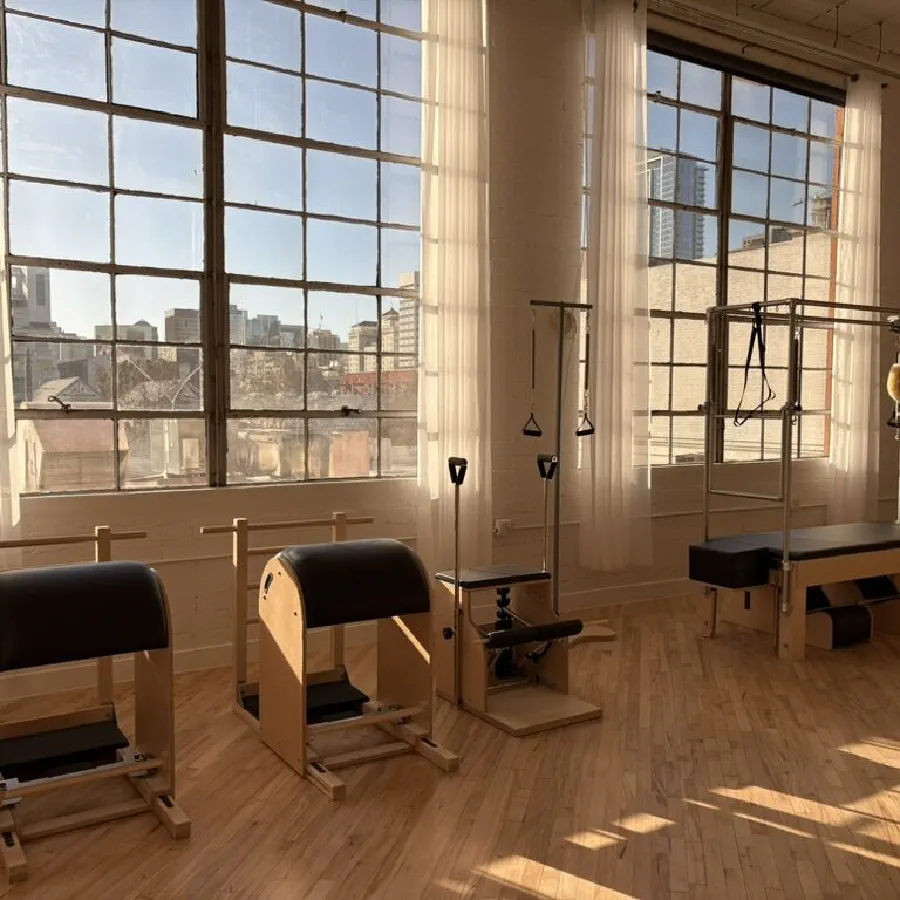
You show up every week and you know your way around a reformer. So why does that one hip still hike?
Your instructor is good; the room is the constraint
Picture 50 minutes and 10 to 12 people, the size of a typical San Diego group reformer class. Even the best instructor has to aim cues at the average body in the room, because that’s who most of the room is.
I want to say this up front: nothing here is a knock on group class. (We love group class, for the record.) It’s built for the room.
Here’s who feels the limit most: capable movers who show up every week. You’ve got the basics down, so the things left to fix are the specific ones. Those are hard to reach from the front of a class.
After your next class, I’d ask one question: was there a cue that didn’t quite fit your body? That’s the gap we’re talking about.
The side that always works harder
One hip hikes. One shoulder shrugs. One foot grips. You can often see it in a group, but the cue goes to the room, not to the side that needs it.
In a private, the cue lands on that side every rep. That’s the whole difference.
Your takeaway: if you have a side that always works harder, I’d call that a private-sized problem. Next class, notice which side it is and write it down so you can name it.
The history your body actually carries
Group programming assumes a baseline. Old surgeries, disc issues, and shoulder injuries don’t fit a baseline.
In a private, your instructor programs around your history, so you’re not left modifying quietly in the corner. That’s the extent of the promise: Pilates doesn’t diagnose, treat, or heal anything.
If you have pain that’s new, severe, or getting worse, see a clinician first. Then bring what they tell you to your private so your instructor can plan around it.
Breath, sport, and posture habits need close attention
Three things are hard to change from across a room.
- Breath. In my experience, many adults breathe high, with the shoulders rising on the inhale. A verbal reminder rarely changes that. Hands-on cueing is what I rely on in my sessions.
- Sport. If you run, surf, golf, or play tennis, your body has a one-sided story. General-fitness reformer doesn’t address it. A private is where Pilates becomes training for the thing you love.
- Posture. Forward head, anterior pelvic tilt, and wing-y shoulder blades get named and unlearned in front of a mirror, with someone who can tell you what they see.
Your action: pick the one of these you recognize most and bring it to your first private.
What a private adds to what you already do
A private is an addition to group, not a replacement. One hour, one body, one plan.
Keep your Sunday class. Use the private to work on what the class can’t reach, then take it back into the room with you.
Here’s a self-check. Which of the five is yours: the side that works harder, the history, the breath, the sport, or the posture habit? Whichever you picked, I’d make it your agenda for the hour.
Try the other side of Pilates
A first private is for you if you already take group class and want to see what close attention feels like. There’s no pressure to switch anything.
The hour itself has a shape, which we cover in our post on what happens in your first private session.
You’ve already built the consistency, and a private adds the precision to match it.
Find your instructor
Instructors at Inspired Studios in downtown San Diego set their own first-private offers. For example, Mather Method Pilates, my own practice, offers its group class clients a first private for $75 for one hour, with a plan built around your body. You keep your group classes and gain a place where your side, your history, and your habits get the attention. DM us “PRIVATE” and we’ll match you with the right instructor.